
Following Data From One Device to Another
Network Data Does Not Travel as One Untouched Piece of Information
When one computer sends information to another, the application does not simply place the original data directly onto a cable. Networking functions prepare that information for transmission, identify where it needs to go, organize it for the network technology being used, and ultimately represent it as signals that can cross the physical medium.
The receiving system performs the complementary process. It receives the signals, interprets the network information surrounding the data, and progressively delivers the useful information to the application that needs it.
One Transmission Involves Several Different Jobs
An application may care about the message itself, while other networking functions deal with reliable delivery, addressing, local network access, framing, and the physical signal. Separating those responsibilities makes complex communication easier to understand.
Seven Layers Provide a Framework for Understanding Those Jobs
The Open Systems Interconnection model, better known as the OSI model, organizes network communication into seven conceptual layers. The original article correctly describes it as a theoretical framework rather than the protocol architecture that directly runs modern networks.
Real networks are commonly discussed through the TCP/IP model and the actual protocols they use, but the OSI model remains valuable because it provides a consistent vocabulary for separating networking functions and reasoning about where a problem occurs.
A Model Is Not the Network Itself
The seven layers are a conceptual way to organize networking responsibilities. Actual protocols and devices do not always fit into those boundaries as neatly as an educational diagram might suggest.
The Application Layer Is Closest to the Networked Application
The application layer represents network services used by software. Web communication, email, file transfer, name resolution, and many other network functions involve application-layer protocols that allow programs on different systems to exchange useful information.
This does not mean that every application itself is literally part of the OSI application layer. The layer describes the network-facing services and protocols that applications use to communicate.
The User Cares About the Result
A person opening a webpage cares about receiving the page. The lower networking functions are responsible for making that exchange possible without requiring the user to manage frames, addresses, signals, or routing manually.
The Presentation Layer Describes How Information Is Represented
Two systems need to interpret exchanged information in compatible ways. The presentation layer provides a conceptual place for functions involving data representation, translation, encoding, encryption, and compression.
The original article associates this layer with formatting and character encoding. In practical networks, these functions may be handled by protocols, libraries, applications, or other parts of the software stack rather than by a distinct piece of software labeled Presentation Layer.
The Session Layer Represents the Management of Communication Sessions
Communication between applications may involve establishing, maintaining, coordinating, and eventually ending an interaction. The session layer represents those responsibilities within the OSI framework.
As with the presentation layer, real implementations do not necessarily provide a separate identifiable session-layer component. The value of the model is recognizing session management as a communication function rather than expecting every modern network stack to expose seven physically separate pieces.
Conceptual Layers Can Overlap in Real Software
Application, presentation, and session responsibilities are often combined within modern applications and protocols. The OSI model separates them because the functions themselves remain useful to distinguish.
The Transport Layer Manages Communication Between Endpoints
The transport layer deals with communication between endpoints and can provide functions such as segmentation, reliability, ordering, flow control, and error recovery depending on the transport protocol being used.
TCP and UDP are two familiar transport protocols in the TCP/IP suite. They provide very different services. TCP establishes a connection and provides reliable ordered delivery, while UDP provides a simpler datagram service without TCP’s reliability and ordering mechanisms.
TCP
Provides connection-oriented communication with sequencing, acknowledgments, retransmission, and mechanisms intended to deliver an ordered stream reliably between endpoints.
UDP
Provides connectionless datagram delivery with considerably less protocol overhead, leaving applications to handle additional reliability or ordering when those functions are required.
The Network Layer Handles Logical Addressing and Routing
Communication frequently has to travel beyond the local network. The network layer provides logical addressing and the mechanisms needed to move packets between networks.
IP addresses operate here. Routers examine network-layer information and determine where packets should be forwarded next so that traffic can progress toward its destination.
Does a Router Need to Know the Entire Journey?
Not necessarily. A router generally needs enough routing information to determine an appropriate next destination for the packet. Additional routers can continue forwarding it until the traffic reaches the network containing the final destination.
A Packet Can Cross Several Networks Before Reaching Its Destination
Sending data to another device on the same local network is different from sending it to a remote network. When the destination is elsewhere, the sending system normally forwards the traffic toward a router that can move it beyond the local network.
From there, the packet may pass through multiple routing devices and network links. The underlying data-link technology can change during that journey even though the network-layer addressing continues to guide the packet toward its destination.
The network path is not one enormous cable between two computers. It can be a sequence of different links joined by devices that forward traffic from one network toward another.
The Data Link Layer Organizes Communication Across a Local Network Segment
At the data-link layer, information is organized into frames appropriate for the local network technology. Ethernet is one of the most familiar examples.
This layer deals with functions such as local addressing and access to the transmission medium. Ethernet interfaces use MAC addresses as part of delivering frames across the local link.
IP and MAC Addresses Perform Different Jobs
An IP address helps identify a network-layer destination across interconnected networks. A MAC address participates in delivering frames across a particular local data-link environment. They should not be treated as interchangeable identifiers.
Ethernet Switches Forward Frames Across the Local Network
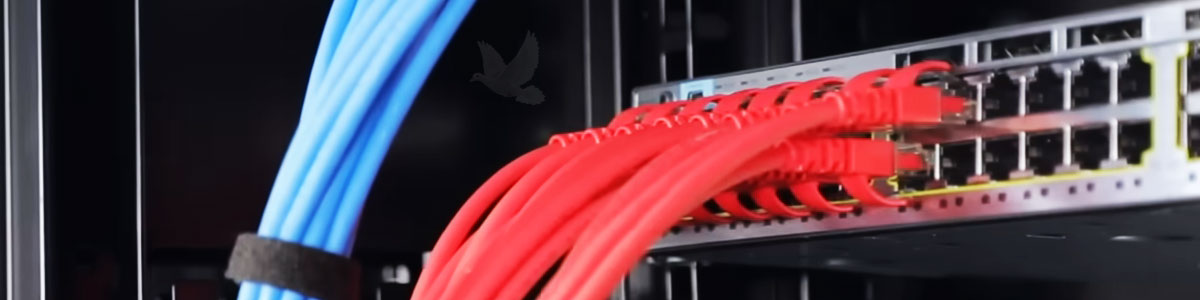
The network equipment shown in the article image includes switches with Ethernet cables connected to their ports. A switch receives Ethernet frames and uses data-link information to determine where those frames should be forwarded within the local network.
A switch can learn which MAC addresses are reachable through its ports and use that information when forwarding traffic. This allows communication to be directed toward the appropriate part of the switched network instead of treating every transmission as though all connected devices need to receive it.
A Switch and Router Solve Different Problems
An Ethernet switch primarily forwards frames within a data-link environment, while a router forwards packets between IP networks. Many networks use both because local communication and communication between networks require different functions.
The Physical Layer Carries Bits Through the Transmission Medium
Eventually the information has to become something that can physically travel. The physical layer concerns the signaling, connectors, media, electrical or optical characteristics, timing, and related mechanisms used to carry bits between devices.
With copper Ethernet, communication is represented through electrical signaling across the cable. Fiber-optic networking uses light. Wireless networking uses radio. The physical mechanism changes, but each provides a way for information represented digitally by the system to cross a real transmission medium.
The Cable Does Not Understand the Application
A copper cable does not know that it is carrying a webpage, file, email, or video. At the physical level, its job is to carry the signals required by the networking technology.
Each Stage Adds Information Needed for Its Own Responsibility
As application data moves through a networking stack, protocols add control information needed to perform their particular jobs. This general process is called encapsulation.
The original article describes the process as each OSI layer adding a header and possibly a trailer while data moves toward the physical layer. That is useful conceptually, although actual encapsulation follows the protocols in use rather than requiring every OSI layer to add a distinct header.
Transport Information
Transport protocols can add information needed to identify application endpoints and provide the delivery behavior required by that protocol.
Network Information
Network-layer information includes logical addressing and other fields required to move packets toward their destination.
Link Information
The data-link layer surrounds the network-layer packet with information required to carry it across the current local link.
The Receiving Device Works Back Toward the Application
When the transmission reaches the destination, the receiving system interprets the incoming signal and processes the information according to the protocols involved. Data-link information is handled, the network-layer packet is processed, transport information reaches the appropriate endpoint, and the useful data is eventually delivered to the application.
This reverse progression is often described as decapsulation. The control information that made transmission possible has served its purpose, allowing the receiving application to work with the information it actually requested or was sent.
The Message Survives While Its Wrapping Changes
The useful application information can remain conceptually the same while different protocol information is added, examined, replaced, or removed as the transmission moves through networking systems.
Opening a Website Activates Several Networking Functions
Consider a computer requesting information from a web server. An application-layer protocol defines the web exchange. Transport communication carries the application data between endpoints. IP addressing allows packets to travel toward the server’s network.
On the local Ethernet network, frames carry those packets toward the appropriate next device. The physical interface converts the transmission into signals that cross the cable. Routers can then forward the packets through additional networks until they reach the destination.
The response follows the same broad principle in the opposite direction, eventually reaching the original computer and being delivered to the application that requested it.
One User Action Can Involve Many Protocols
Typing an address and opening a webpage looks like one action from the user’s perspective, but the network performs numerous addressing, transport, forwarding, framing, signaling, and application functions to make that result possible.
Standards Allow Equipment From Different Manufacturers to Communicate
Networking would be considerably more difficult if every manufacturer implemented incompatible methods of connecting devices. Standards define common technical behavior that allows independently produced hardware and software to interoperate.
The original article identifies the IEEE 802 family as an important source of networking standards and specifically mentions Ethernet, wireless LANs, network access control, and Token Ring.
IEEE 802.3
The IEEE 802.3 family defines Ethernet technologies used extensively for wired local-area networking.
IEEE 802.11
The IEEE 802.11 family defines wireless LAN technologies commonly known through the Wi-Fi ecosystem.
IEEE 802.1X
IEEE 802.1X provides a framework for port-based network access control and authentication in supported network environments.
Older Standards Help Show How Networking Has Evolved
The original article also lists IEEE 802.5 Token Ring. Token Ring is now a legacy technology, but its presence in older networking material is useful because it demonstrates that the dominant technologies used to build local networks have changed considerably over time.
Ethernet became overwhelmingly dominant for wired LANs, while Wi-Fi became central to wireless local networking. The standards continue evolving even though the basic need remains the same: devices require agreed methods for exchanging information.
Standards Evolve Without Erasing Networking Fundamentals
Speeds, media, connectors, wireless techniques, and protocol capabilities change. Addressing, forwarding, encapsulation, signaling, interoperability, and reliable communication remain fundamental problems that networks still have to solve.
The Seven Layers Are Most Useful When They Explain the Journey
Memorizing Application, Presentation, Session, Transport, Network, Data Link, and Physical can help identify the seven OSI layers, but the model becomes far more useful when those names are connected to what happens during an actual transmission.
Data begins with an application purpose, gains the information necessary to travel, crosses local and potentially remote networks as physical signals, and is processed by the destination until useful information reaches the receiving application. The OSI model provides a framework for examining that journey one responsibility at a time.
