

Finding the Reason a MacBook Pro Is Not Behaving Normally
A MacBook Pro can arrive with a clear symptom while the actual cause remains completely unknown. It may refuse to start, shut down unexpectedly, behave erratically, lose a function, or simply do something that cannot be explained from the outside.
Diagnostics is the process of narrowing that uncertainty. The reported behavior provides a starting point, but conclusions should come from what can be observed, tested, and measured inside the computer rather than from the symptom alone.
The Same Behavior Can Point in Several Directions
What a MacBook Pro does provides valuable information, but a symptom rarely identifies one component by itself. Different faults can produce remarkably similar behavior, which is why diagnosis becomes a process of eliminating possibilities rather than choosing the most obvious explanation.
Initial Checks Can Eliminate Entire Possibilities
Start With What Can Be Confirmed
Good diagnostics becomes more useful as assumptions are replaced with observations. Before opening a MacBook Pro or concentrating on an individual component, basic behavior can reveal which parts of the computer are still functioning and which expected events are missing.
A machine that recognizes its charger but will not start presents a different path from one that shows no response to external power at all. Likewise, a MacBook Pro that appears to complete startup without producing an image is behaving differently from one that never progresses through the startup sequence.
These distinctions help determine what should be tested next. Each confirmed behavior reduces the number of plausible explanations and prevents unrelated areas from receiving attention simply because they could theoretically produce a similar symptom.
The process becomes progressively narrower: observe what works, identify what does not, and move the investigation toward the point where normal behavior stops.
Sometimes the Evidence Leads Inside the Power and Control Circuits
When the earlier checks eliminate simpler explanations, the investigation may eventually reach the logic board. At this stage, diagnosis changes from observing what the MacBook Pro does to examining the electrical conditions that allow particular circuits to operate.
Measurements can show whether expected voltage is present, whether a power rail is missing, or whether a circuit is behaving differently from what should normally occur at that stage of operation. Instead of treating the entire logic board as one possible failure, the objective is to progressively isolate the area associated with the symptom.
A missing electrical condition can then become another clue. The investigation can move backward or forward through the relevant circuit to determine where normal behavior changes, allowing attention to concentrate on a much smaller portion of the board.
This is where component-level diagnostic work becomes useful. The question is no longer simply “Why doesn’t the MacBook Pro work?” It becomes much more specific: “Where does the expected electrical behavior stop?”
What Board Testing Can Reveal
Expected
A circuit has conditions that should be present when it reaches a particular stage of operation. Those expectations provide a reference for evaluating what is actually measured.
A Reading Matters Because It Tells Us What Is Different
A multimeter can produce a number almost anywhere on a MacBook Pro logic board. The important part is understanding whether that number makes sense for the circuit, operating state, and point being examined.
Voltage, resistance, and continuity measurements can be compared with the electrical behavior expected in that area. When the results agree, one possibility may become less likely. When they do not agree, the difference provides another direction for the investigation.
This prevents board diagnostics from becoming a collection of random measurements. Each test should answer a question created by the evidence gathered before it. One result determines whether attention remains in that area or moves somewhere else.
As those comparisons accumulate, a large and complicated logic board can gradually be reduced to a particular circuit, connection, or group of components that deserves closer examination.
Measured
The actual reading shows what the circuit is doing at that moment. A meaningful difference between expected and measured behavior gives the diagnosis somewhere specific to continue.
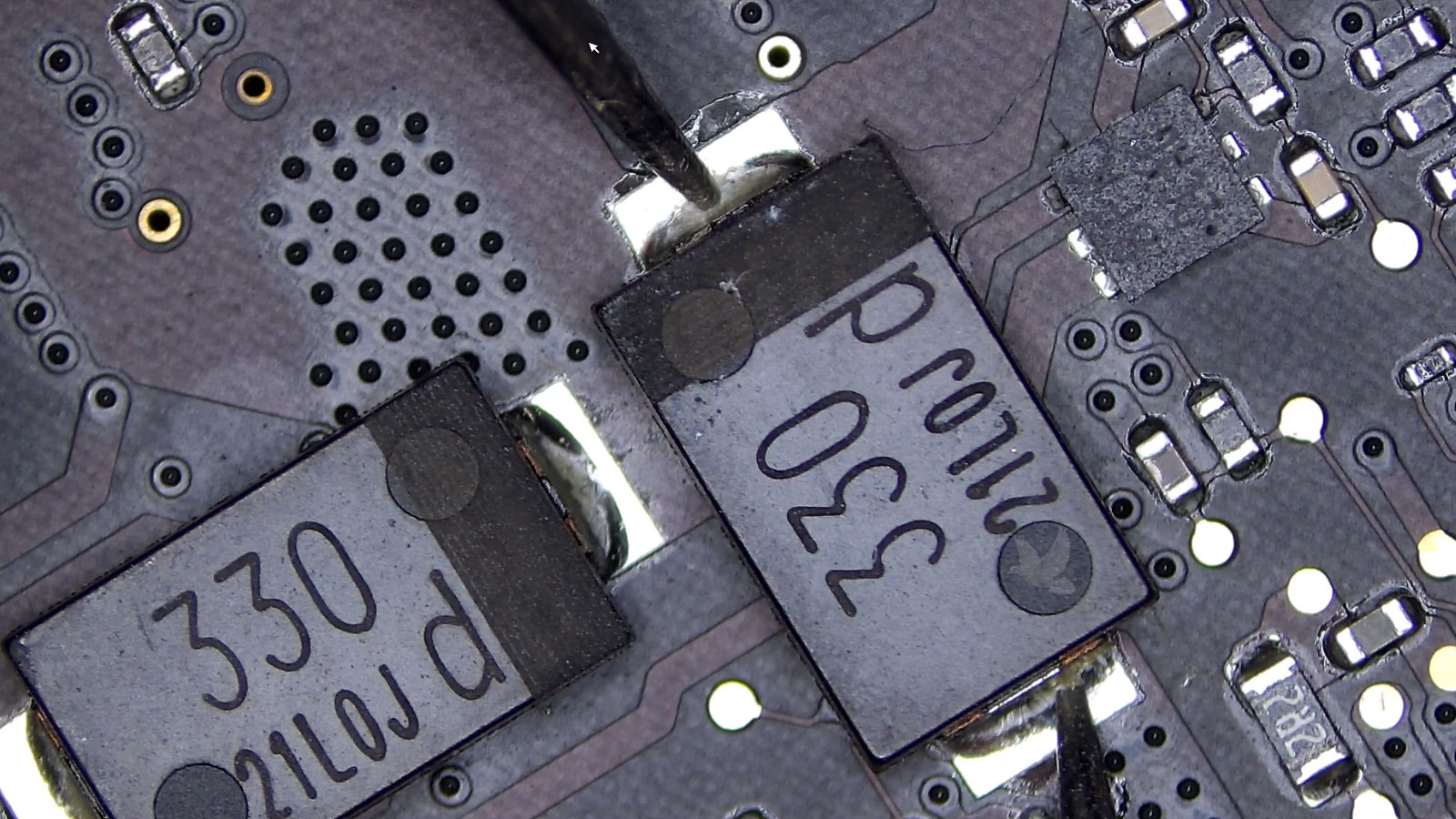
The purpose of deeper testing is to make the area under investigation smaller, not larger.
A Logic Board Fault Can Eventually Become a Component-Level Question
Once measurements repeatedly lead toward the same area, the investigation becomes increasingly focused. Instead of considering the entire logic board, attention can move to the components, connections, and signals associated with the affected circuit.
At this stage, magnification and direct electrical testing become especially useful. Individual points can be measured, surrounding components compared, and the relationships within the circuit examined for evidence that explains the original behavior of the MacBook Pro.
Finding something unusual still does not mean the first suspicious component should automatically be replaced. The surrounding circuit matters because one abnormal condition can sometimes be the consequence of a fault elsewhere.
The Useful Result Is Knowing What Needs Attention Next
A completed diagnosis should turn an unexplained MacBook Pro problem into something specific enough to act upon. The original symptom may have started the investigation, but the final conclusion should identify where the evidence leads and what that means for the next step.
That distinction matters because different findings can lead to very different repair decisions.
| Diagnostic Finding | What It Establishes | Direction From There |
|---|---|---|
| Replaceable hardware fault | Testing identifies a particular part or assembly responsible for the behavior. | The appropriate hardware repair or replacement can be considered. |
| Board-level fault | Measurements narrow the problem to a circuit, connection, or component on the logic board. | Component-level repair can be evaluated according to the confirmed fault. |
| No fault reproduced | The reported behavior does not occur during the initial testing conditions. | Additional observation or information about when the problem occurs may be necessary before reaching a conclusion. |
| Multiple related findings | Testing reveals more than one condition contributing to the MacBook Pro’s behavior. | The findings can be considered together before deciding which work is appropriate. |
Diagnosis should reduce uncertainty before repair begins, not move the uncertainty into the repair itself.
Turn an Unexplained Problem Into a Repairable Answer
When a MacBook Pro has a problem but the cause is still uncertain, diagnostics can provide the information needed before deciding what should be repaired. The process can begin with the reported behavior and continue as far as necessary, from basic functional checks to electrical measurements and component-level investigation.
MacBook Pro diagnostic service is available in Miami for computers with unexplained startup failures, charging problems, display issues, intermittent behavior, unexpected shutdowns, and other symptoms that require the actual cause to be identified.
The objective is not to attach a repair to a symptom. It is to determine what the evidence supports so the next decision is based on a specific finding.
Find Out What the MacBook Pro Actually Needs
If the problem is still unknown, the MacBook Pro can be examined to narrow the fault and determine where attention should go next.
For Miami customers who prefer not to transport the MacBook Pro themselves, pickup can be arranged at no charge, with the computer returned after service.