
When Stored Information Becomes Inaccessible
Lost Data and Destroyed Data Are Not Always the Same Thing
A document can disappear from a folder even though information belonging to that file still remains somewhere on the storage device. A partition can become inaccessible while much of its underlying data remains intact. A hard drive can stop operating even though information is still magnetically recorded on its platters.
Data recovery is the process of attempting to retrieve information that can no longer be accessed normally. The possibilities depend on what happened to the device, how the information was stored, and what occurred after the loss was discovered.
The Failure Determines the Recovery Strategy
Recovering an accidentally deleted file is fundamentally different from recovering information from a hard drive with damaged read-write heads. Before attempting recovery, determine whether the problem is logical, electronic, mechanical, or a combination of failures.
What Happens After Data Loss Can Matter as Much as What Caused It
The original article warns that recovery attempts can make a situation worse. That principle is especially important when continued use can overwrite recoverable information or when a mechanically failing device can sustain additional physical damage.
If important data suddenly disappears, avoid unnecessary writing to the affected storage device until the nature of the failure is understood.
Do Not Install Recovery Software Onto the Drive You Are Trying to Recover
Installing software, downloading files, performing updates, or continuing ordinary computer use can write new information to storage areas that may contain remnants of deleted data.
Data Loss Can Occur Without the Storage Device Being Physically Broken
The original article identifies accidental deletion, formatting, operating-system corruption, and hardware failure as common causes of lost information. Those causes fall into very different recovery categories.
Logical Loss
Files, partitions, or file-system structures become inaccessible even though the storage hardware may still operate normally.
Electronic Failure
Controller circuitry, power components, interfaces, firmware, or other electronics prevent normal access to the storage medium.
Mechanical Failure
Moving components inside a hard drive, including the head assembly or spindle system, can prevent the platters from being read normally.
Deleting a File Does Not Necessarily Erase Every Piece of Its Data Immediately
When a file is deleted, a file system may mark its occupied space as available rather than immediately overwriting every underlying storage location. Until that space is reused, some or all of the deleted information may remain recoverable.
The more the storage device is used afterward, the greater the possibility that newly written information will replace storage locations associated with the deleted file.
Stop Writing to the Device
When an important file is accidentally deleted, minimizing subsequent writes can preserve more of the original storage state for examination and possible recovery.
Formatting Can Change the File System Without Physically Destroying Every Previous Byte
The old article specifically includes formatted hard drives among recoverable data-loss situations. Whether recovery remains possible depends on the type of formatting, the storage technology, subsequent writes, and what changes were made to the underlying data structures.
A newly formatted volume may no longer contain the original directory information in the form expected by the operating system even though portions of previous file content remain elsewhere on the storage medium.
Formatted Does Not Describe One Single Condition
Different formatting operations and storage technologies can produce very different recovery prospects. The word formatted alone is not enough to predict whether particular files remain recoverable.
The Data Can Still Exist Even When the Computer Cannot Organize It
A file system contains structures that tell the operating system how stored information is organized into files, directories, allocation records, metadata, and available space.
If those structures become damaged, the operating system may report that a volume is unreadable, unformatted, corrupted, or unavailable even though substantial file content remains on the device.
Inaccessible Does Not Automatically Mean Empty
A damaged directory or file-system structure can prevent normal access without proving that the underlying file content has disappeared from the storage medium.
A Missing Partition Can Make an Entire Volume Appear to Vanish
Partition information describes how regions of a storage device are organized for use. Damage to that information can make a previously accessible volume disappear or appear incorrectly to the operating system.
Recovery may involve examining the device independently of the damaged partition information to determine whether the expected file system and data structures still exist.
Do Not Repartition Important Lost Data Without Understanding the Situation
Creating new structures on a device containing inaccessible information can alter the original state and complicate subsequent recovery.
A Mechanical HDD Stores Data on Magnetic Platters
A hard disk drive contains rotating platters coated with magnetic material. Read-write heads move across those platter surfaces while the drive’s electronics and mechanical systems coordinate access to stored information.
If the computer cannot communicate normally with the drive, the data can become inaccessible even though portions of the magnetic information remain physically present on the platters.
Heads
The read-write head assembly must operate correctly and position itself accurately to retrieve information from the platter surfaces.
Spindle
The platter assembly must rotate correctly for the drive to access the magnetic surfaces as designed.
Electronics
Controller circuitry and firmware coordinate the electrical and mechanical functions required for the drive to operate.
Clicking or Repeated Mechanical Activity Can Change the Recovery Decision
A hard drive that repeatedly clicks, attempts to spin, stops, disappears from the computer, or behaves differently each time power is applied may have a physical or electronic problem rather than ordinary file-system corruption.
Repeatedly powering a mechanically damaged drive can subject already compromised components and platter surfaces to additional operation.
A Failing Mechanical Drive Is Not a Good Place for Experimentation
If the information is important and the drive shows signs of physical failure, repeated startup attempts and generic repair utilities can reduce the opportunity for controlled recovery.
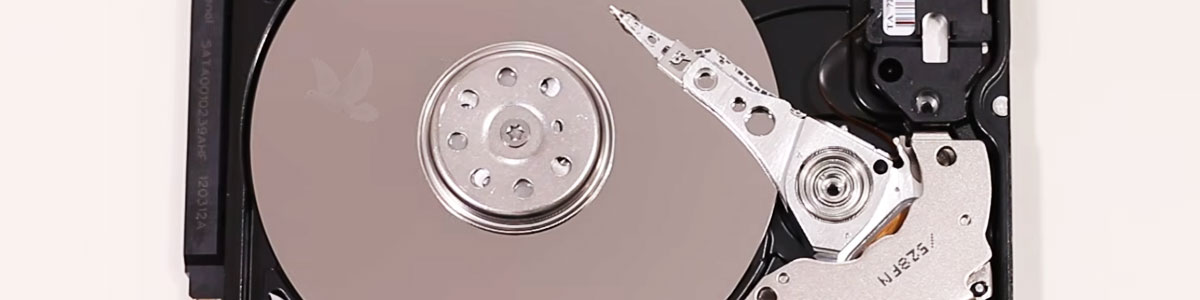
The Drive in the Article Image Has Crossed Into Physical Recovery Territory
The image above shows a mechanical hard drive with its cover removed, exposing the platters and mounted read-write head assembly. Opening a conventional HDD is not part of ordinary software-based data recovery.
The internal platter environment is extremely sensitive to contamination and physical contact. Once a drive requires internal mechanical work, the recovery problem is fundamentally different from retrieving deleted files from an otherwise healthy disk.
Opening a hard drive is not a way to look for the lost files. It exposes the precision mechanical system that must read the magnetic information stored on the platters.
Hard Drive Heads Operate Extremely Close to the Platter Surface
The read-write heads in a mechanical drive operate with extraordinarily small clearances. Dust, debris, fingerprints, physical contact, or damage to the platter surface can interfere with a system designed to operate at microscopic tolerances.
For that reason, an HDD should not be opened casually simply because it has stopped working.
Do Not Remove the Cover to Inspect a Failed HDD
Seeing the platters does not provide access to the files, and exposing the internal assembly can introduce contamination into a device that may already have a recoverable failure.
Recovery Often Begins by Preserving What Can Still Be Read
When a failing storage device remains partially readable, one approach is to create an image or controlled copy of accessible sectors onto another storage device. Recovery work can then proceed against that copy rather than repeatedly stressing the original media.
A failing device may not respond consistently, so data acquisition can require different handling from an ordinary file copy.
Preserve First, Analyze Second
When possible, separating acquisition from file recovery reduces the amount of subsequent work performed directly against the original failing storage device.
A Drive Can Be Partially Readable Rather Than Completely Dead
Some storage failures affect particular regions while other areas remain readable. A normal copy operation may repeatedly stop or retry when it encounters unreadable sectors.
Recovery-oriented imaging can prioritize obtaining readable information and record areas that could not initially be acquired, depending on the condition of the device and the tools being used.
One Unreadable Area Does Not Necessarily Mean Every File Is Lost
The effect depends on which storage locations are damaged and which files or file-system structures depended on those locations.
Solid-State Drives Create a Very Different Recovery Problem
The original article includes SSDs among the storage devices from which data may need to be recovered. Unlike an HDD, an SSD has no magnetic platters or mechanical read-write head assembly.
SSDs store information in NAND flash memory managed by a controller. Logical addresses presented to the computer are translated internally to physical flash locations, and the controller performs operations such as wear leveling, garbage collection, and error correction.
HDD Recovery Techniques Do Not Transfer Directly to SSDs
The technologies store and manage information differently, so failure behavior and recovery possibilities can differ substantially even when the visible symptom is simply that the drive is no longer accessible.
Deleted SSD Data Can Behave Differently From Deleted HDD Data
Modern solid-state storage can receive commands indicating that particular logical blocks are no longer needed. The SSD can then prepare those flash locations for future use through its internal management processes.
This means that assumptions about deleted-file recovery developed around traditional magnetic hard drives do not always apply to SSDs.
Deletion Does Not Have Identical Recovery Prospects on Every Device
The file system, operating system, storage interface, controller behavior, encryption, TRIM support, and subsequent device activity can all affect whether deleted information remains recoverable.
USB Drives and Memory Cards Can Lose Data Too
The source lists USB flash drives, CompactFlash cards, and SD cards alongside HDDs and SSDs. These devices use solid-state storage but can fail because of damaged connectors, controller problems, flash degradation, electrical damage, file-system corruption, or accidental deletion and formatting.
A device that no longer mounts normally may therefore have either a logical problem or a hardware problem.
USB Flash Drives
Portable flash storage can suffer connector damage, controller faults, NAND problems, corruption, or accidental data loss.
SD Cards
Memory cards used in cameras and other devices can become unreadable, corrupted, formatted, or physically damaged.
Other Flash Media
Different physical formats can use similar underlying flash technologies while employing different controllers and interfaces.
Recovering Raw Data Is Not Always Enough to Recover Usable Files
Modern computers and storage devices can use encryption to protect information. If the recovered data remains encrypted, access can depend on the required password, recovery key, hardware-backed credentials, or other cryptographic information.
Encryption therefore changes the recovery problem. A successful physical acquisition of storage contents does not automatically mean the recovered information can be decrypted.
Protect Recovery Keys Before a Failure Occurs
When encryption is enabled, the appropriate recovery information can be as important as the storage device itself. Losing both the normal system access and the required recovery credentials can severely limit available options.
Recovered Files May Lose Their Original Names and Folder Structure
When file-system metadata remains sufficiently intact, recovery can sometimes reconstruct original directories, filenames, timestamps, and other information.
When those structures are severely damaged, recovery may instead identify files according to recognizable internal signatures or content. The file itself may survive even though the information describing its original name and location does not.
File Content and File Metadata Are Different Information
Recovering the bytes belonging to a photograph does not necessarily mean its original filename, folder path, or timestamps can also be reconstructed.
Data Recovery Cannot Be Guaranteed From the Symptom Alone
The old article states that almost all data can be recovered and gives a general recovery percentage. In reality, recoverability depends on the specific failure and the condition of the information that remains.
Overwritten sectors, severe platter damage, destroyed flash memory, missing encryption credentials, extensive corruption, or continued use after deletion can make particular information partially recoverable or permanently unavailable.
Can the Data Be Recovered?
The reliable answer usually comes from examining the actual storage device and failure rather than from the visible symptom alone.
Recovery Should Write Results Somewhere Else
Recovered files should normally be saved to separate storage rather than written back onto the original source device during the recovery process.
Keeping the source unchanged preserves the remaining evidence and avoids overwriting areas that could contain additional recoverable information.
Source and Destination Should Be Different Storage
The device being recovered should not also be the destination for recovered files when doing so would alter storage areas that still need to be examined.
A Failed Storage Device Should Not Become the Only Home for Important Data Again
Once information has been recovered from failing hardware, the recovered files should be verified on reliable storage. The failed device should not be trusted simply because some data could still be read from it.
The event is also an opportunity to reconsider backup practices so that a future device failure does not create the same single point of loss.
Recovery Is the Emergency Procedure, Backup Is the Prevention
Data recovery attempts to retrieve information after normal access has failed. A backup provides another copy before that failure occurs.
The Best Data Recovery Situation Is the One That Never Becomes Necessary
Important information should exist in more than one place. A second copy protects against storage failure, while additional independent or appropriately isolated copies can provide protection against accidental deletion, malware, theft, physical damage, and other events.
A backup strategy should also be tested. A copy that cannot be restored when needed does not provide the protection its owner expected.
Multiple Copies
Important information should not exist only on the computer or storage device currently being used.
Separate Failure Paths
At least one backup should avoid depending on exactly the same device, location, or failure condition as the original data.
Test Restoration
Periodically verify that important backed-up information can actually be accessed and restored when required.
When Data Disappears, Protect What Still Exists
A deleted file, formatted volume, corrupted file system, failed SSD, damaged memory card, and mechanically failing hard drive can all produce the same frightening result: important information is suddenly unavailable. Underneath that symptom, however, the recovery problems are very different.
The safest response begins by preserving the storage device in its current condition, identifying what kind of failure occurred, and choosing a recovery method appropriate to that technology and failure. Sometimes the solution is logical file recovery. Sometimes it requires controlled imaging. And when a mechanical hard drive reaches the condition shown in the article image, recovery can extend all the way into the precision hardware responsible for reading the platters themselves.
