
When Poor Performance Develops Into Complete Failure
A Computer Can Give Warning Signs Before It Stops Working
Slow performance, freezing, unusual noises, overheating, intermittent shutdowns, and difficulty starting can appear long before a computer reaches a complete failure. Sometimes those symptoms share the same underlying cause. In other cases, an older performance problem and a later no-power condition are entirely separate failures.
The important part is not to assume that the final symptom explains everything that happened before it. A computer that was slow yesterday and completely dead today still needs a diagnosis capable of separating software, storage, cooling, power, and motherboard problems.
Follow the Symptoms in the Order They Appeared
A failure history can reveal whether performance deteriorated gradually, instability appeared under load, startup became increasingly difficult, or the computer stopped operating suddenly. That sequence can provide useful diagnostic direction.
First Determine Whether the Computer Is Truly Receiving No Power
A computer with no lights, no fan movement, no sounds, and no other response to the power button presents a different problem from a computer that powers on but produces no image.
The original article makes this distinction indirectly by asking users to listen for fans and beep codes after pressing the power button. Any sign of electrical activity can change the direction of the diagnosis.
No Power
No normal electrical response appears when the power button is pressed. The investigation begins with the power path and circuitry required to start the system.
Power but No Display
Fans, lights, or other activity are present, but nothing useful appears on the screen. The computer is receiving at least some power.
Starts Then Stops
The computer begins startup but immediately or intermittently shuts down, creating a different diagnostic condition from complete no power.
Check the Simple Power Path Before Opening the Computer
The original article recommends checking the wall outlet, power cord, surge protector, and other external connections before assuming that the computer itself has failed. Those basic checks remain worthwhile.
A failed outlet, damaged cable, switched-off power strip, defective adapter, or loose connection can imitate a much more serious internal failure.
Confirm the Source Before Diagnosing the Load
If the computer is not receiving the correct input power, troubleshooting internal motherboard circuitry first will send the investigation in the wrong direction.
A Desktop Power Supply Has to Do More Than Receive Electricity
A desktop power supply converts incoming electrical power into regulated outputs used by the motherboard, processor, storage devices, graphics hardware, and other components.
A failed power supply can produce complete no power, intermittent startup, unexpected shutdowns, or unstable operation. Testing should establish whether the required outputs and control behavior are present rather than relying only on whether the power-supply fan moves.
A Spinning Fan Does Not Prove a Power Supply Is Healthy
A power supply can produce enough output for some activity while failing to provide correct voltage or stable operation under the conditions required by the computer.
A Slow Computer Needs Resource and Hardware Diagnosis Before Cleanup
The old article attributes sluggish behavior to accumulated temporary files, unused files, repeated software installation, and general poor maintenance. Some software conditions can affect performance, but a computer does not simply become slow because it has existed for a long time.
Performance changes have causes. Processor load, available memory, storage latency, temperature, background software, operating-system problems, malware, failing hardware, and the demands of the workload can all influence how responsive a computer feels.
Slow Is a Symptom, Not a Maintenance Schedule
Determine which resource or component is limiting performance before deleting files, replacing hardware, reinstalling the operating system, or running optimization utilities.
A Busy Processor Can Make an Otherwise Healthy Computer Feel Unresponsive
Applications, background services, updates, security scans, browser processes, synchronization software, and other workloads can consume processor resources. When demand approaches the computer’s available processing capacity, other tasks may respond more slowly.
Unexpected processor usage can therefore provide useful information, but the process responsible for that activity still has to be identified before deciding whether the behavior is normal or problematic.
High CPU Usage Is Information
The percentage alone does not identify a failure. A demanding application may legitimately use substantial processor resources, while unexplained activity at idle deserves a different investigation.
Insufficient Available RAM Can Shift More Work Toward Storage
Applications and the operating system use memory for active instructions and data. When the workload requires more memory than is comfortably available, the system may rely more heavily on virtual memory and storage activity.
That can make application switching, startup, and general responsiveness noticeably slower, particularly when the underlying storage device is also slow or unhealthy.
Is the Computer Slow All the Time or Only With Certain Workloads?
A system that performs normally until several demanding applications are opened can present a different problem from one that is extremely slow immediately after startup.
A Failing Drive Can Turn Performance Problems Into Data Problems
The original article correctly calls attention to clicking or ticking sounds from mechanical hard drives, especially when they occur alongside freezing or slow performance.
Storage problems can cause long boot times, applications that hesitate while opening files, freezes during disk access, corrupted information, or repeated operating-system errors. Mechanical noises from an HDD can indicate a substantially different situation from ordinary software slowdown.
Important Data Changes the Priority
If a mechanical hard drive begins clicking or repeatedly disappears while important information exists only on that device, protecting the data can be more important than continuing ordinary performance troubleshooting.
Overheating Can Reduce Performance Before It Causes Instability
Modern processors and graphics hardware generate substantial heat under load. Cooling systems move that heat away so components can remain within their intended operating ranges.
If cooling becomes inadequate, the system may reduce operating performance to control temperature. More severe thermal problems can contribute to freezes, shutdowns, or other instability.
Performance Can Be a Thermal Symptom
A computer that becomes progressively slower during sustained work may require temperature and cooling investigation rather than software cleanup.
Fan Behavior Can Provide Clues but Not a Complete Diagnosis
The old article identifies power-supply, CPU, and graphics-card fans as common desktop cooling components. Depending on the computer, additional chassis fans or other cooling devices may also be present.
A fan running continuously at high speed can indicate elevated temperature or aggressive cooling demand. A fan that does not rotate may be defective, intentionally stopped by its controller, or simply not required at that moment depending on the system design.
Listen, Observe, Then Measure
Unusual fan behavior is useful evidence, but temperature readings and system behavior provide better diagnostic context than fan noise alone.
A Slow Internet Connection Is Not the Same as a Slow Computer
The original article suggests that slow Mac performance is often related to Internet speed because many activities depend on online services. That distinction needs to be made more carefully.
A slow network connection can make websites, cloud synchronization, streaming, downloads, and online applications respond slowly while the Mac itself remains perfectly responsive. Local operations such as opening System Settings, navigating folders, or launching an installed application can help distinguish computer performance from network performance.
Computer Performance
Processor load, memory pressure, storage behavior, temperature, software, and hardware influence how quickly the local computer performs work.
Network Performance
Connection speed, latency, Wi-Fi conditions, routing, service congestion, and remote servers influence how quickly online information arrives.
Malware and Unwanted Applications Can Consume Resources
The source identifies viruses, spyware, Trojans, adware, and bundled utilities as possible contributors to poor computer performance. Suspicious or unnecessary background software can indeed consume processor time, memory, storage activity, and network resources.
That possibility should be investigated when the evidence supports it, but malware should not become the default explanation for every computer that runs slowly.
Be Careful With Programs Promising Instant Optimization
Utilities advertised as cleaners or performance boosters can themselves add startup processes, notifications, background activity, or unwanted software. Install software because it solves a defined problem, not because a warning claims the computer needs immediate optimization.
Instability Before No Power Can Be Important Diagnostic History
A computer that occasionally failed to start before becoming completely dead presents useful historical information. So does a system that shut down under load, froze as it became hot, or required several power-button attempts before startup.
Intermittent electrical faults can progress as components deteriorate, solder connections change with temperature, or power circuitry becomes increasingly unstable.
Ask What the Computer Did Before It Died
The final no-power condition is important, but the preceding days or weeks can contain clues that disappear once the system no longer starts at all.
The Motherboard Contains Multiple Power Stages Rather Than One Power Circuit
Computer motherboards distribute and regulate different voltages for processors, memory, storage interfaces, controllers, chipsets, communication devices, and other circuitry.
Some power rails are required before the computer can respond normally to the power button. Others appear later as the startup sequence progresses. A failure in the wrong part of that sequence can leave the machine appearing completely lifeless.
No Power Does Not Automatically Mean a Dead Power Supply
The external supply can be functional while a motherboard fault prevents the control sequence or required internal voltage rails from operating correctly.
A Shorted Power Rail Can Prevent the Computer From Starting
If a component develops an abnormal low-resistance path to ground, the affected power circuit may be unable to establish its intended voltage. Protection circuitry can also prevent further startup when an abnormal electrical condition is detected.
Resistance measurements on appropriate unpowered circuitry can help identify whether a rail behaves abnormally, but the expected reading depends on the design of that particular circuit.
Low Resistance Does Not Automatically Mean a Short
Some high-current, low-voltage circuits naturally measure relatively low resistance. Electrical readings need to be interpreted according to the circuit being tested.
Electrical Measurements Can Show Where Expected Power Stops
Once external power and the primary supply have been established, diagnosis can move through the motherboard’s power sequence. Expected input voltage may be present at one stage but absent after a switching, protection, or regulation component.
Comparing relevant measurements helps narrow a large motherboard into a much smaller electrical area.
A motherboard does not have to be treated as one mysterious component. Voltage and resistance measurements can divide it into circuits that are working and circuits that are not.
The Article Image Shows the Repair After Circuit Diagnosis Narrowed the Fault
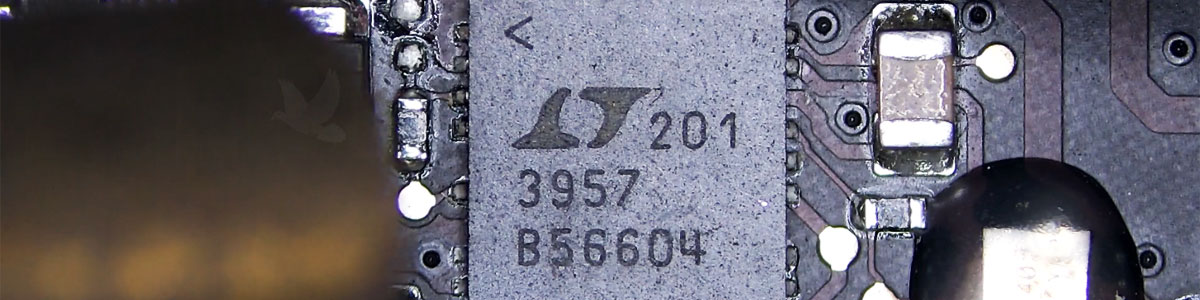
The image above shows an IC marked 201 3957 B56604 being handled with tweezers while hot air is directed at the component area. In this repair, the circuit associated with that IC was identified during diagnosis of the computer’s no-power condition.
The important part of the process occurs before component removal. Measurements and circuit behavior must provide a reason to suspect the component or the electrical path around it.
The Hot Air Station Is Not the Diagnostic Tool
Hot-air rework is used during component-level repair. The diagnosis should already have established why work is being performed in that area of the motherboard.
Removing an IC Requires Controlled Heat and Careful Board Handling
Surface-mounted integrated circuits are attached to pads on the circuit board. Rework can require controlled heating, appropriate airflow, suitable tools, protection of surrounding components, and careful handling of the board.
Too much heat can damage pads, laminate, nearby components, connectors, or the replacement device. Too little heat can encourage excessive mechanical force while solder joints remain attached.
Do Not Pull a Component That Is Still Soldered
The component should release when the solder has reached the appropriate state. Mechanical force against attached pads can turn a component replacement into circuit-board damage.
The Circuit Should Be Checked Again Before a Replacement Is Trusted
Removing a suspected component creates another opportunity to measure the circuit. If an abnormal condition disappears after the device is removed, that result can strengthen the diagnosis. If the abnormal condition remains, another component on the same electrical path may still be responsible.
The board should also be inspected for damaged pads, contamination, displaced nearby components, or other problems before a replacement is installed.
Did Removing the Component Change the Fault?
That measurement can provide valuable confirmation before the repair proceeds further.
The New Component Has to Match the Electrical Requirements of the Circuit
Package size alone does not establish compatibility. Pin arrangement, electrical characteristics, operating limits, component function, and other specifications can determine whether a replacement is suitable.
After installation, solder joints and surrounding components should be inspected before the motherboard is powered for functional testing.
Component Identification Comes Before Installation
A part that physically fits the pads can still be electrically incorrect for the circuit.
The First Successful Startup Is Evidence but Not the End of the Repair
After a no-power motherboard repair, confirm that the expected power sequence has returned and that the computer can start repeatedly rather than only once.
Charging behavior where applicable, processor operation, memory, storage, graphics, networking, ports, temperatures, and other relevant functions may require testing depending on the computer and the original failure.
Repair Includes Verification
A computer that powers on after component replacement has passed an important test. It has not necessarily passed every test required to establish stable operation.
Power Restoration Does Not Automatically Explain the Earlier Slow Performance
If the computer was noticeably slow before the motherboard failed, that performance condition should be evaluated again after power has been restored.
The repaired electrical fault may have contributed to instability, but the system could also have a separate storage, memory, thermal, software, or operating-system problem that remains after the no-power repair.
Do Not Lose the Original Complaint
When a dramatic failure such as no power occurs, earlier symptoms can easily be forgotten. A complete repair returns to those symptoms and verifies whether they were resolved or require separate diagnosis.
From Slow Performance to No Power the Evidence Should Lead the Repair
A computer that becomes slow, unstable, and eventually completely unresponsive can appear to have one continuously worsening problem. Sometimes it does. Sometimes several unrelated conditions happened in sequence.
The correct approach is to establish what each symptom means. Performance problems require examination of processor activity, memory, storage, temperature, software, and hardware. A true no-power condition shifts the investigation toward the external supply, power sequence, motherboard rails, and individual circuits. In the repair shown above, that process ultimately reached the 201 3957 B56604 IC and the component-level work required around it.
